
Approximately 600 family-wage jobs during peak construction, resulting in an estimated $79 million in earned wages and benefits.
Cancel
Top tips

THREE POINTS SOLAR
THREE POINTS SOLAR
Harvesting the Wind to Power an Economic Boon to Pima County
Repsol Renewables is developing a 500-megawatt (MW) Solar and Battery Storage project in Pima County, Arizona. Once operational, the Three Points Solar project would generate enough electricity to power more than 124,000 Arizona homes annually. With some of the highest solar resources in the country, the Three Points Solar Project will deliver steady, clean, and efficient energy to meet the growing demand in the region.

Why Pima County?
Why Pima County?
Repsol Renewables has identified the area within Pima County as ideal for solar development because of the on-site existing transmission system with available capacity, an excellent solar resource, , and minimal anticipated environmental impacts.
To read some of the most frequently asked questions about the Three Points Solar project, see below.
Long-Term Benefits to Pima County
Solar power provides millions of dollars to the county’s economy every year, particularly in rural areas where projects are located. The Three Points Solar project represents a capital investment of more than$1 billion which will result in significant economic benefits for Pima County.
Approximately 15 long-term, local jobs during operations, resulting in an estimated $3 million in wages and benefits annually.
Paying more than $200 million of property tax revenues over 40 years to fund schools and other critical services within Pima County, with an annual average of $5.2 million, which includes:
- More than $1.7 million annually to the Altar Valley School District
- More than $1.4 million annually to the Pima County general fund
- More than $1.2 million annually to the Three Points Fire Department
Paying sales tax revenues on construction materials collected by Pima County.
Approximately $91 million in lease payments to the Arizona State Land Department which benefit state public schools and universities.
Increasing business activity among local hotels, motels, restaurants, grocery stores, gas stations, and more.
Enhancing local economic impact by sourcing Arizona-based equipment, materials, and labor when feasible during development, construction, and operations.
Developing long-term partnerships with local organizations, schools, and community members.
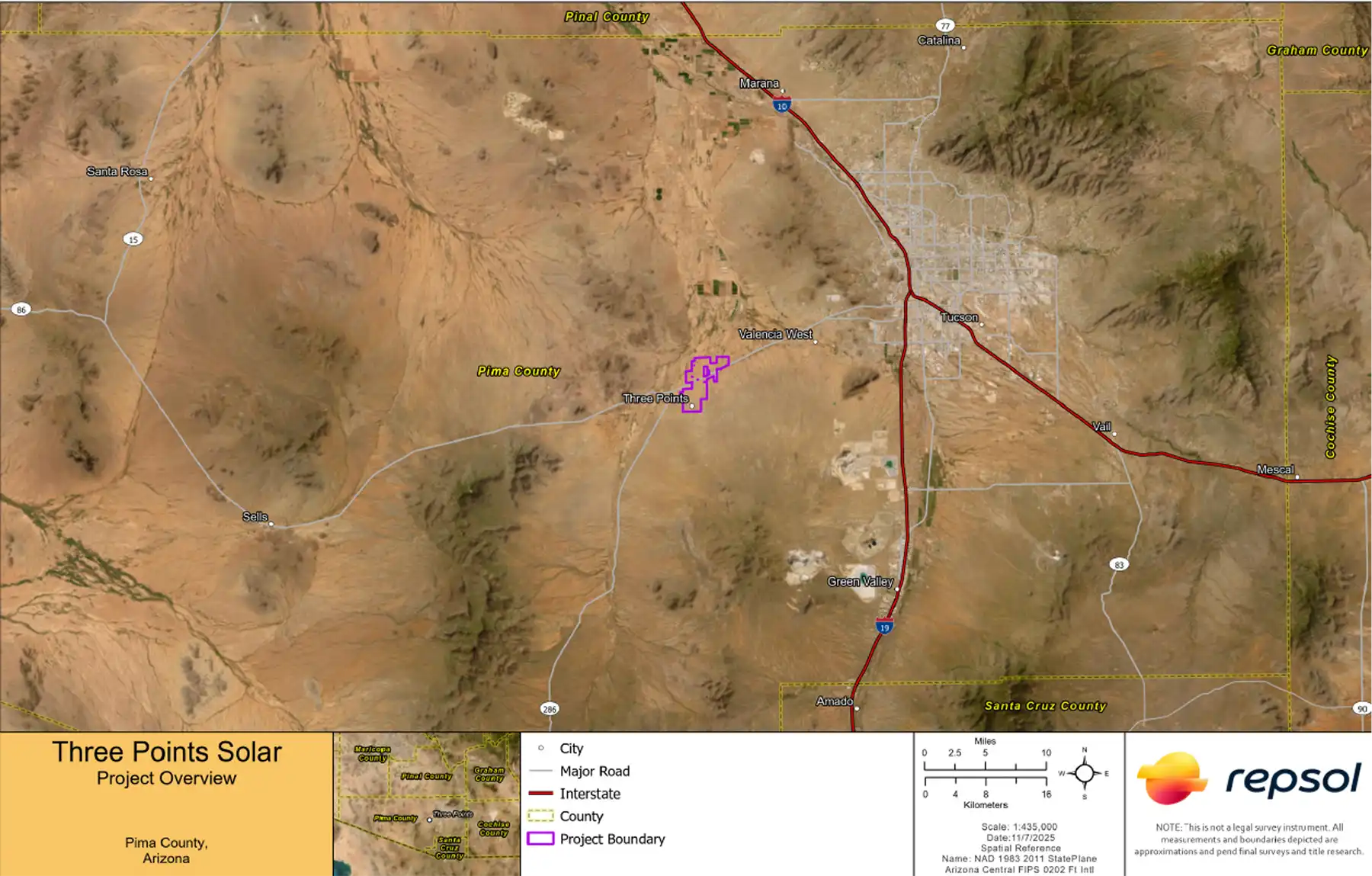
Three Points Solar Project Area
Three Points Solar Project Area
The Three Points Solar project will be located approximately 20 miles southwest of Tucson, entirely on State-owned land currently managed for grazing activities and will interconnect onto the Tucson Electric Power’s Pinal West to South 345 kV Line. The project is located near Robles Junction along highway Ajo Way.
The Arizona State Land Department (ASLD) has a statutory mandate to maximize the revenue generated through the use and lease of state land for the State Land Trust Beneficiaries, which are primarily state public schools and universities. The Three Points Solar project will pay $91 million to ASLD over its estimated 40-year operational life, which will go towards K-12 public education, agricultural and mechanical colleges, and the University of Arizona School of Mining and Mineral Resources, among others.
Project Development to Date
Interconnection
Repsol (formally ConnectGen) first submitted its interconnection application in 2021 and signed a Large Generator Interconnection Agreement with Tucson Electric Power in 2026
Land
The project is sited entirely on Arizona State Land Trust parcels. Three Points has sole rights to develop in this area and is working with the ASLD to secure a lease.
Environmental and Engineering
Completed Studies:
- Site Characterization Report (habitat), Aquatic Resource Report, Phase 1 ESA, Preliminary Geo-technical Report, Preliminary Hydrological report. Preliminary Design, Class III Cultural Study, Natie Plant Inventory, ALTA Survey, Visual Study, Economic Impact Report
Studies in progress or scheduled to start:
- Pima Pineapple Cactus Study, Cactus Pygmy Owl Assessment,
Schedule
The project is currently scheduled to start construction in 2027 and begin commercial operation in 2029.
Stakeholders engaged
The project has engaged Arizona Game and Fish, Arizona State Land Office, Arizona SHPO, US Fish and Wildlife Service, Pima County Community Development, Pima County Conservation Lands and Resources, Pima County Flood District, Three Points Fire District, Altar Valley Conservation Alliance, Coalition for Sonoran Desert Preservation, The 12 southern Arizona Native Nations including the Pascua Yaqui and Tohono O’odham.
Repsol Renewables is Committed to Siting the Three Points Solar Project Responsibly and Safely
Below are the ways in which we will minimize potential impacts of the project.
Wildlife
Work with state and federal agencies and stakeholders to ensure that potential environmental impacts are fully considered, minimized, and mitigated.
Visual
Conduct a visual impact assessment to analyze the Project’s visibility from various key observation points.
Early and Often Communication
Repsol is committed to early and often communication with local stakeholders, project neighbors, and key groups to understand and address concerns and build long term and mutually beneficial relationships in the immediate project area.
Closure
Implement financial securities that will guarantee responsible decommissioning and restoration at the end of the Project’s life.
Energy Independence
Generate local clean energy that strengthens the grid and reduces emissions through resource diversity.
Get the Facts
Learn more about the Three Points Solar project here! Below are answers to some of the most-asked questions about solar energy.
Repsol Renewables North America is wholly owned by Repsol, a global multi-energy company that leads the energy transition and has set itself the goal of being zero net emissions by 2050.
With a portfolio of over 20,000 MW of wind, solar, and storage projects under development across the United States, Repsol Renewables North America’s experienced team has a track record of successfully identifying, developing, and building renewable energy projects. Our project successes are built on a foundation of rigorous screening and site selection, collaborative engagement with landowners and host communities, and disciplined execution through development, construction and operations.
Solar photovoltaic (PV) panels are constructed of silicon, tempered glass, electrical wiring, and polymers and are mounted upon a steel frame called racking. Silicon, a scientific element most commonly found in sand, has conductive properties that allow it to absorb and convert sunlight into electricity. The interaction of sunlight with a silicon cell sets in motion the electrons in silicon. This movement initiates the flow of electric current in a process known as the “photovoltaic effect.”1
Other project infrastructure present at a solar project includes common electrical equipment such as power inverters (which convert direct current (DC) power to alternating current (AC) power), transformers (which “step up” the voltage of the power to a higher kV rating for transmission on the power grid), underground collector lines, overhead transmission lines, and a substation.
Solar projects provide numerous benefits to the communities in which they are sited. Solar projects represent significant local investments and drive meaningful increases in the local taxable property base. Solar projects also provide guaranteed annual property tax payments to local taxing jurisdictions, which allow county and local officials to make long-term financial plans and increase spending on public services and other critically important infrastructure. In addition, these projects directly create hundreds of full-time equivalent jobs during the construction and installation phases and also support indirect and induced jobs during development and construction. The Three Points Solar Project also intends to establish a Community Investment Program to fund community initiatives and establish long-term partnerships with local organizations.
Solar power is a reliable source of energy, with solar projects now operating in all 50 states across the U.S.2 A solar project will produce power most days of the year, even under cloudy conditions, and in some cases, clouds can result in better panel performance. Further, a recent industry trend is the use of bifacial solar panels, which have solar cells that capture sunlight from the front of the panel as well as sunlight that is reflected off the ground. These panels have been shown to yield 11% more energy than standard solar panels in a tilted, ground-mounted solar installation,3 and during peak winter months, bifacial modules have been shown to perform as much as 40% better than single-sided panels.4
No electricity source runs 100% of the time, including coal, gas, and nuclear plants. While solar is variable as a power source, its variability can be predictably forecast and used to complement other generation sources. Grid operators have decades of experience managing changes in supply and demand, including the gradual, predictable changes in solar output.5
Yes. Solar power is now one of the cheapest sources of new electricity in most of the world due to declining equipment costs, improved technologies, and public policies which support the generation and use of renewable energy.6
In the last decade, the cost to install solar has dropped significantly.7 According to Lazard’s Levelized Cost of Energy Analysis – Version 18.0 (2025), even without tax credits, new solar resources have a levelized cost of energy in the range of 3.8¢/kWh – 7.8¢/kWh for large-scale solar. This range falls below the levelized cost of energy for new coal or gas combined cycle power production.8 These results have been bolstered by the International Energy Agency’s World Energy Outlook 2024, which found that “Solar PV and wind are now the cheapest sources of electricity in most markets.”9
Adding to their growing appeal, solar projects are uniquely able to sell their electricity output at a fixed price over the life of the project because the “fuel” is free and not subject to increases in commodity fuel prices.10
Yes. Solar panel materials are enclosed with glass and an aluminum frame and do not mix with water or vaporize into the air, so there is no risk of chemicals, including greenhouse gases, being released into the environment during normal use. Crystalline silicon PV panels, which represent approximately 90% of the solar panels in use today, do not pose a material risk of toxicity to public health and safety.11
All solar facilities are designed to strict electrical safety standards to ensure safe operation. Product safety standards, installation requirements, and building codes for solar facilities are addressed by the National Fire Protection Agency’s National Electrical Code, the International Code Council’s International Fire Code, the International Association of Firefighters, and several other national, state and local safety and product standards groups.12
No. To ensure decades of corrosion-free operation, solar panels are also encapsulated between two layers of transparent plastic to prevent exposure to the ambient air and moisture. These encapsulation layers are further protected with a layer of tempered glass on the front and a polymer sheet on the back. For decades, this same material has been used between layers of tempered glass to give car windshields and hurricane windows their great strength, allowing them to stay intact, even if damage occurs.13
Solar facilities are very quiet neighbors, generating little sound and minimal traffic while in operation during daylight hours. Inverters are the main source of sound with typical noise levels averaging 75 decibels (dBA) at the point source, which is equivalent to the sound of a hair dryer or vacuum cleaner.15 Sound levels drop off quickly from the point source, resulting in much lower noise levels at the project boundary. At night, solar projects do not generate power and the potential for sound creation decreases. Further, our projects will be designed to comply with state and local laws to limit sound impacts.
No. Property value studies conducted across the country have shown that proximity to large-scale solar projects does not measurably impact property values or deter the sale of agricultural or residential land.16
Solar projects benefit all local property owners by driving economic investment and tax revenue. These funds improve roads, schools, and community services, while also keeping local taxes low – all of which factor into property values.17
When sited and developed properly, a solar facility is expected to have minimal impacts on wildlife in the area. In fact, studies show that solar facilities can provide shelter for species, promote land stability, preserve habitat, and support biodiversity.18 The seeding of stable, year-round herbaceous cover post-construction will likely benefit many wildlife species (i.e., ground-nesting birds, pollinators, etc.).
To better understand potential impacts, we will be completing environmental studies that will categorize existing habitat and wildlife within the project area. These studies will inform project design and construction activities so that wildlife and their habitat may be avoided.
Once constructed, solar projects produce no pollution or emissions. Furthermore, native vegetation can grow under the panels, and solar facilities can provide sanctuaries for flora and fauna to thrive.19
Glint refers to the direct reflection of the sun on a solar panel. Glare is a continuing source of brightness, not the direct reflection of the sun. Solar arrays are designed to absorb light and produce electricity, not reflect it. The panels that we will use have an anti-reflective coating, which helps to increase the amount of light absorbed into the cell, thereby increasing efficiency and reducing glare and allowing the panels to blend in more easily with the surrounding area.
The Project will use a solar panel tracking system, allowing the reflective surfaces to align with the sun as it moves across the sky. Therefore, due to continuous tilt, water will not collect on the panels during rainstorms. The rainwater that runs off the panels is absorbed into the ground, nurturing the groundcover. Any excess rainwater leaves the site as stormwater runoff, just as it does now. Working with the county flood district and the Altar Valley Conservation Alliance, the project will ensure that it will either not affect the current water flows or improve and slow stormwater runoff.
Solar panels do not require water to produce electricity. The only significant water use by the project will be for dust suppression during construction, on an as-needed basis. During construction, it is anticipated that water will either be purchased from a local water supplier and trucked to the site.
Further, throughout most of the US, the climate provides frequent and heavy enough precipitation to keep solar panels clean. This dependable weather pattern minimizes the need to wash panels on a regular basis.20 If washing does occur, we will use distilled water, because groundwater can leave a film or deposits on the panels.
The Project will be monitored during operating hours by onsite staff. The entire property will also be monitored remotely 24 hours a day, 7 days a week.
Maintenance crews will maintain the perimeter and interior landscaping within the project boundaries. The interior ground cover shall not exceed 18 inches, with a typical maximum height of 12 inches, so that it doesn’t interfere with the panels or other electrical components.
Yes, a variety of native grass and forb species will be planted to establish vegetative cover in all areas of the project outside of the graveled areas for access roads and substation locations. These grassy areas will be similar to existing conditions in the area and will serve to minimize the potential for soil erosion on site. The project is working with the Pima County Conservation Lands and Resource team to build a robust vegetation management plan to limit impacts on native species and study conditions on site.
We will develop a Stormwater Pollution Prevention Plan (SWPPP), which will outline the plans for sediment and erosion controls to manage both the amount and composition of any stormwater discharged from the project site.
We have entered into road use agreements with Logan County, Menard County, and the three townships (Middletown, Corwin, and Hurlbutt) in which the project is located. These road use agreements minimize the potential effects on local roads by outlining the process of improving and repairing roads that will be used during construction and operations. We will conduct a before-and-after visual inspection to ensure that the roads are left in as good or better condition as they were prior to construction. In addition, financial assurance will be in place in the amount necessary to repair any damage to public roads caused by construction and operations.
Yes. The exterior boundary around solar panels is fenced for security and safety reasons. Collection easements between panel areas are typically not fenced to allow larger wildlife to traverse to the project areas without disruption. Wherever feasible, the project will utilize Arizona Game and Fish and Pima County approved wildlife friendly fencing which allows for animals uninhibited travel through the project site.
Yes. Prior to operation, we will develop an Emergency Response Plan in accordance with industry best practices. The Plan will outline the response procedures to be employed should an emergency arise at the Project site. We will work closely and collaboratively with the local departments and authorities. We provide pre-construction training to all emergency response personnel, which includes a description of the Project, any potential construction risks, and the role of emergency responders should an incident occur. After construction is complete, we will host the emergency response personnel for a site visit to make sure they are familiar with the system and our Emergency Response Plan.
In the event of an emergency, local emergency service providers will take the most direct/fastest available route to the site, depending upon current conditions and their starting location. We will communicate with local emergency service providers and share copies of the Security Plan and Safety Response Plan. All access roads installed as part of the project will be designed for emergency service access with 20-foot widths, emergency vehicle load bearing capacity, turnarounds on each road, and emergency responder accessible gating.
We will develop and implement a Vegetation Management Plan that establishes vegetation goals and identifies the specific treatments that may be used to ensure safe and reliable operation of each solar project. Common practices to control and manage vegetation will involve mechanized and agrarian means; however, herbicides may be employed, depending on the target plant species, land use activities and landowner input. We are committed to the conscientious use of appropriate management techniques to control vegetation in a way that is designed to minimize the risk of unreasonable adverse effects on human health and the environment.
PV panels are designed to last more than 25 years, and many manufacturers offer performance guarantees backed by warranties.21 Like many other durable products and construction materials, solar equipment can last for decades with proper maintenance, of which they require very little due to the presence of very few, if any, moving parts.22 Proper operations and maintenance can increase efficiency, extend a project’s lifetime, and ensure safety.23 Prior to construction, we will develop and implement an Operations and Maintenance Plan based on industry best practices and site-specific environmental conditions.
Our lease agreement states that the company is responsible for the decommissioning and removal of project infrastructure at the end of each project’s life. Standard decommissioning practices include dismantling and repurposing, salvaging/recycling, or disposing of the solar energy improvements, and restoration.
The Arizona State Land Department requires a Decommissioning Plan be put in place, which outline the various ways in which the project owner will safely and responsibly remove installed equipment and restore the property within the project area. In addition, the Arizona State Land Department requires the project owner to post financial security (i.e., decommissioning or surety bond), prior to commencement of construction, in the amount necessary for the removal of project infrastructure and site restoration, to be adjusted by inflation regularly. The decommissioning bond will further ensure that host communities bear no financial burden for decommissioning and restoration activities.
No, the panels will not increase ambient air temperatures for residents in the neighborhood. While studies have indicated that temperatures are higher in the immediate vicinity of the project, these temperatures dissipate completely within 50 feet. All the solar panels will be set back from residences by at least 250 ft and therefore will not cause any increase in temperatures for project neighbors.24
Solar PV panels typically consist of glass, polymer, aluminum, copper, and semiconductor materials,25 which can be safely disposed of in landfills at the end of the project life. In addition, recycling technologies have emerged in the last several years that have enabled these materials to be recovered and recycled at the end of their useful life.26 PV solar panel recycling technologies have been put in place over the last decade that have been shown to recover over 95% of semiconductor materials and over 90% of the glass in the panel.27 In other cases, solar PV components can be reused or refurbished to have a “second life” of generating electricity.28 The industry continues to work with recycling partners and to research and explore additional cost-effective recycling technologies.29
1 https://news.energysage.com/solar-panels-work/.
2 https://seia.org/solar-state-by-state/
4 https://www.pv-magazine.com/2020/02/07/solar-and-the-snow/
7 https://www.seia.org/solar-industry-research-data
8 https://www.lazard.com/media/eijnqja3/lazards-lcoeplus-june-2025.pdf
10 https://www.nrel.gov/docs/fy13osti/59065.pdf.
12 https://seia.org/initiatives/environmental-health-safety/
14 https://www.nature.com/articles/ncomms13728.
15 https://ehs.yale.edu/sites/default/files/files/decibel-level-chart.pdf.
16 https://cleanpower.org/wp-content/uploads/2023/08/Solar-and-Property-Values-Fact-Sheet_0823.pdf
18 https://www.solarpowerworldonline.com/2019/03/utility-scale-solar-wildlife-stewardship/.
19 https://cleanpower.org/wp-content/uploads/gateway/2024/02/Solar-on-AG-Land_240911.pdf
21 https://www.seia.org/initiatives/recycling-end-life-considerations-photovoltaics
22 https://news.energysage.com/how-long-do-solar-panels-last/
23 https://www.nrel.gov/docs/fy17osti/68281.pdf
24 https://phys.org/news/2016-11-solar-island-effect-large-scale-power.html
26 https://www.irena.org/publications/2016/Jun/End-of-life-management-Solar-Photovoltaic-Panels.
27 https://iea-pvps.org/wp-content/uploads/2020/01/IRENA_IEAPVPS_End-of-Life_Solar_PV_Panels_2016.pdf.
28 https://www.seia.org/initiatives/recycling-end-life-considerations-photovoltaics.
29 https://www.seia.org/initiatives/seia-national-pv-recycling-program.
Contact Us
Contact Us
Your opinion matters. Please share your questions, ideas and thoughts by contacting us through one of the avenues below.
Project Manager: Name
Email: info@threepointssolar.com
Toll-free voicemail: (###) ###-####