
Energy Security Generate local clean energy that strengthens the grid through resource diversity and low-cost power
Cancel
Top tips

PIKE CREEK WIND
PIKE CREEK WIND
Harvesting the Wind to Power an Economic Boon to Logan County
Repsol is developing an approximately 200 MW wind project in Logan County, IL. Once operational, the Pike Creek Wind project would generate enough electricity to power more than 65,000 Illinois homes annually.

Why Logan County?
Why Logan County?
Repsol has identified the area within Logan County as suitable for wind development because of its proximity to the existing transmission system with available capacity, a compatible wind resource, site suitability with existing land use, and minimal anticipated environmental impacts.
To read some of the most frequently asked questions about the Pike Creek Wind project, see below.
Long-Term Benefits to Logan County
Wind power pumps billions of dollars into the country’s economy every year, particularly in rural areas where wind projects are located. The Pike Creek Wind project represents a capital investment of $350 million, which will result in significant economic benefits for the area.
At least 125 jobs during peak construction, as well as 20 long-term, local jobs during operations
$58.2 million in property tax revenues over 35 years to fund schools and other critical services within Logan County
Increasing business activity among local hotels, motels, restaurants, grocery stores, gas stations, and more
Enhancing local economic impact by sourcing Illinois-based equipment, materials, and labor when feasible during development, construction, and operations
Developing long-term partnerships with local organizations, schools, and community members
Pike Creek Wind Project Area
Pike Creek Wind Project Area
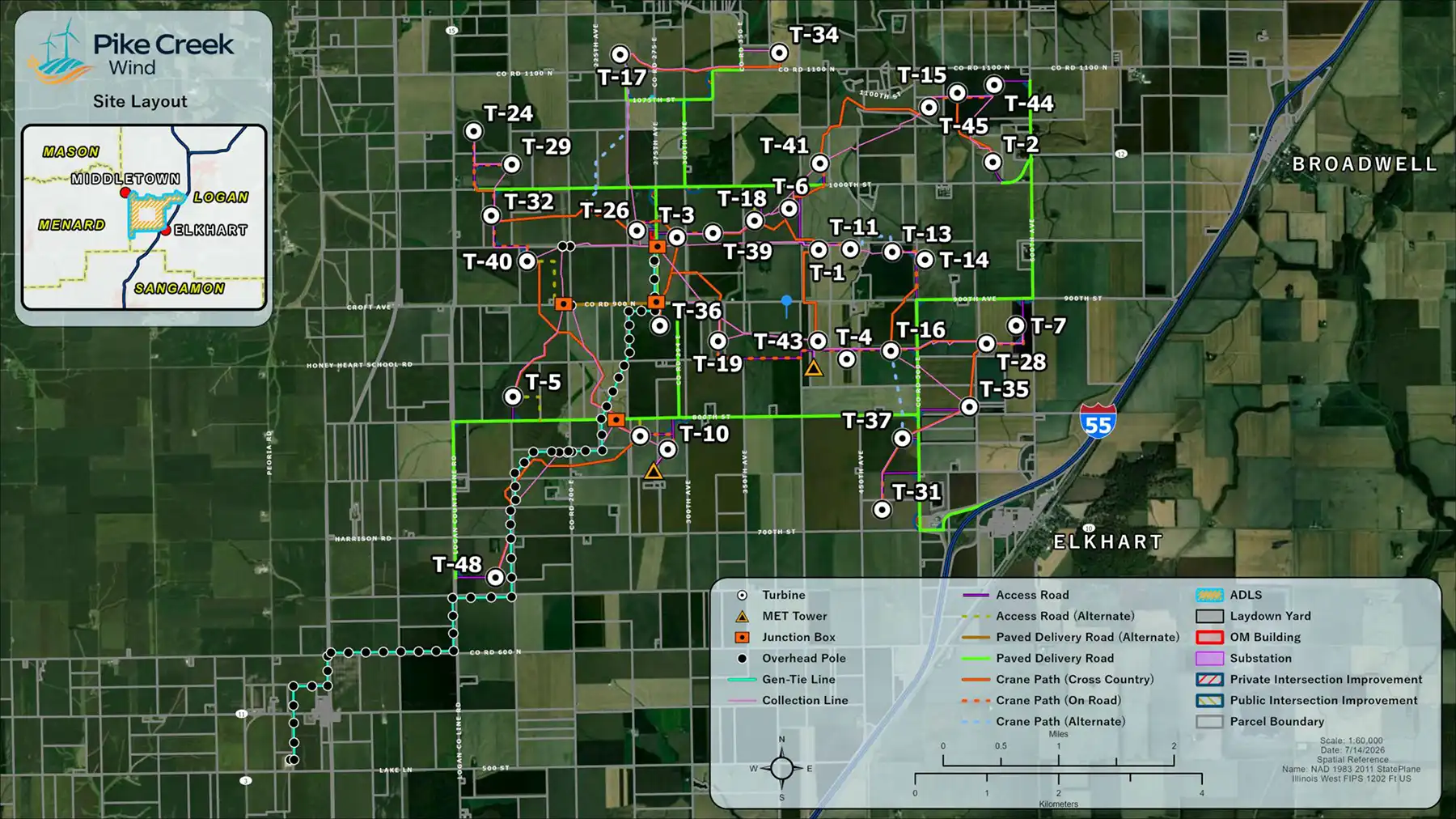
Repsol Renewables is Committed to Siting the Pike Creek Wind project Responsibly and Safely
Below are the ways in which we will minimize potential environmental impacts of the project.
Wildlife
Work with state and federal agencies and stakeholders to ensure that potential environmental impacts are minimized and mitigated, including impacts to local species and other natural resources
Sound and Shadow Flicker Modeling
Ensure that sound and shadow flicker generated by the project is in strict compliance with state of Illinois regulations and Logan County’s wind ordinance requirements
Decommissioning and Financial security
Maintain a decommissioning plan and financial securities approved by the County that will guarantee responsible decommissioning and restoration of the land at the end of the project’s life
Get the Facts
Learn more about the Pike Creek Wind project here! Below are answers to some of the most-asked questions about wind energy.
When the wind blows past a wind turbine, its blades capture the wind’s energy and rotate, turning the wind’s kinetic energy into mechanical energy. Inside the wind turbine, this rotation turns an internal shaft connected to a gearbox, which then spins a generator that produces electricity. The wind turbine will rotate to face the strongest wind and will angle its blades to best capture the wind energy.1
A typical modern turbine will start to generate electricity when wind speeds reach six to nine miles per hour (mph), known as the cut-in speed. Turbines will shut down if the wind is blowing too hard (roughly 55 miles an hour) to prevent equipment damage. Over the course of a year, modern turbines can generate usable amounts of electricity over 90% of the time. For example, if the wind at a turbine reaches the cut-in speed of six to nine mph, the turbine will start generating electricity. As wind speeds increase, so does electricity production.2
We have collected and analyzed several years of wind data in our project area to confirm that the wind resource is excellent for wind project operations.
Wind projects provide numerous benefits to the communities in which they are sited. Wind projects represent significant local investments and drive meaningful increases in the local taxable property base. Wind projects also provide guaranteed annual property tax payments to local taxing jurisdictions, which allow county and local officials to make long-term financial plans and increase spending on public services and other critically important infrastructure.
Wind projects pay millions of dollars per year directly to landowners through lease and easement agreements, resulting in a diversified revenue stream that protects against fluctuating commodity prices and preserves family properties for future generations. In addition, these projects directly create up to hundreds of full-time equivalent jobs during the construction and installation phases, support indirect and induced jobs during development and construction, and create long-term jobs to operate and maintain the projects day-to-day.
Onshore wind development has delivered nearly $352 billion of investment across all operational and planned capacity, and in 2025 alone in the U.S., wind projects delivered $2.7 billion in state and local tax payments and land-lease payments.4
The cost of wind has declined by 31% over the last decade, with improved technology and US-based manufacturing making it competitive with other energy sources and the cheapest source of new electricity in many parts of the country.
According to Lazard’s Levelized Cost of Energy Analysis – Version 18.0 (2025), even without tax credits, new wind resources have a levelized cost of energy in the range of 3.7 cents/kWh – 8.6 cents/kWh.4 Wind projects generate electricity at a lower cost per megawatt hour than other possible fossil fuel, and most renewable energy options.5 These results have been bolstered by the International Energy Agency’s World Energy Outlook 2024 which found, “Solar PV and wind are now the cheapest new sources of electricity in most markets.”6
Adding to their growing appeal, wind projects are uniquely able to sell their electricity output at a fixed price over the life of the project because the “fuel” is free and not subject to increases in commodity fuel prices.7
Wind energy is the largest source of renewable electricity generation in the US, providing 10.1% of the country’s electricity and growing.8 While wind is variable as a power resource, that does not mean that wind projects are backed up with a coal or gas plant should the wind stop blowing. The variability of wind can be predictably forecast and used to complement other generation sources. No electricity source runs 100 percent of the time, including coal, gas, and nuclear plants. Grid operators have decades of experience managing changes in supply and demand, and sudden, unexpected outages at large conventional power plants are more costly and difficult to manage than the gradual, predictable changes in wind output.9
Millions of people around the world live and work close to operating wind turbines without any health or safety effects.10
According to a 2018 study by the U.S. Department of Energy’s Lawrence Berkeley National Laboratory,11 there are more than 1.3 million homes in the U.S. located within five miles of a utility-scale wind turbine. The study also found that 92 percent of survey respondents living within five miles of a wind turbine reported positive or neutral experiences and that 90 percent of survey respondents would prefer to live near a wind farm over any type of centralized power plant, whether coal, natural gas or nuclear.
No. Over 20 years of research into the impact of wind turbines on human health indicates that wind turbines, when constructed properly, do not pose a risk to people’s health.12
University researchers, government scientists, and medical and public health authorities have published over 100 peer-reviewed scientific studies on health and living in proximity to wind turbines. These studies have investigated the wide range of purported negative health claims with respect to wind turbines including sound, low frequency noise and infrasound, shadow flicker, and electromagnetic field emissions (EMF). Independent health experts have conducted comprehensive reviews of the existing research and repeatedly conclude that wind turbines do not pose a threat to public health.13
Wind projects do not burn fossil fuel to generate electricity, and as a result, do not emit any air pollutants such as carbon dioxide, sulfur dioxide, nitrogen oxide, or particulate matter. Wind power in the U.S. helps avoid 351 million metric tons of CO2 emissions annually, which is the equivalent to removing 61 million cars from the road.14
Shadow flicker is predictable, harmless, and passes quickly. It is based on the sun’s angle, turbine location, and the distance to an observer. Shadow flicker occurs when rotating wind turbine blades pass in front of the sun and cast a shadow, and numerous health studies have concluded that shadow flicker does not cause negative health impacts to those living in proximity to wind turbines.15 Shadow flicker can be mitigated and minimized with proper planning and siting and cumulatively only occurs for a few hours a year. During cloudy days, shadow flicker does not occur. Further, industry standards and Logan County’s zoning ordinance provide guidance on the recommended 12-month accrued shadow flicker duration to minimize any potential impacts. We design our turbine layouts in accordance with that guidance, and are required by our Conditional Use Permit with Logan County to reduce impacts to less than 30 hours of shadow flicker per “receptor” (home or other inhabited structure) per year.
No, wind turbines are not disruptive to neighbors or harmful to human health. While wind turbines do produce some sound, there is no significant body of peer-reviewed, scientific evidence that clearly demonstrates a direct link between adverse physical health effects and exposure to noise associated with wind turbines.16
Today’s wind turbines take advantage of decades of design, engineering, manufacturing, and operating experience to minimize sound from operations, and the Pike Creek Wind Project has been designed to comply with local and state laws regarding noise limits. A study of the project’s final turbine layout confirmed that noise from the wind turbines would not exceed the state’s or county’s daytime and nighttime noise limits.
No. Your internet and cell phone won’t notice a wind turbine any more than they notice a water tower or grain silo. Wi-Fi operates at very short ranges, so a turbine located hundreds of feet away will not have any effect. Cell towers are networked with multiple overlapping signals and use licensed frequencies that are designed to penetrate obstacles like trees, buildings, and wind turbines. Further, both cell and Wi-Fi services operate on frequency bands and use network architectures that are not affected by wind turbines.
No, wind turbines do not require water to produce electricity or cool power generating equipment, so the project will not have a negative impact on local water supplies. Most of the water needed for the project will be related to dust suppression control during construction, and it is anticipated that water will be purchased from a nearby water control district for that purpose. Furthermore, turbine foundations are only approximately 10-to-12 feet deep and do not impact the local water tables.
This project will not impact ongoing hunting activities on land that is not participating in the project, and there are no restrictions or setbacks that could impact hunting on non-participating properties.
Wind energy projects, like all forms of development, can result in interactions with the natural environment. Wildlife and natural resources are an important consideration in our selection of project sites. Furthermore, the wind energy industry is closely regulated by state and federal agencies to ensure any effects on wildlife are minimized and mitigated.
Our dedicated environmental permitting team and our consultants have conducted several years of surveys of sensitive species such as bats and birds, and have identified mitigation that might be required to address impacts. We work collaboratively with the U.S. Fish and Wildlife Service and state agencies to determine the best siting for wind turbines to minimize any impact on wildlife. The U.S. Department of Energy’s National Renewable Energy Lab noted that wind turbines cause less than 0.01 percent of all human-related bird deaths.22
No. Many studies have shown that wind projects do not have long-term negative impacts on the value of neighboring properties. Wind projects benefit all local property owners by driving economic investment and tax revenue. These funds improve roads, schools, and community services, while also keeping local taxes low – all of which factor into property values.23
The project includes an Aircraft Detection Lighting System (ADLS), which will be installed during the construction phase. The Federal Aviation Administration launched the standards for ADLS technology in late 2015, which is designed to reduce the impact of nighttime lights through the integration of a radar-based system. Unlike traditional wind turbine lighting systems, which remain constantly lit during nighttime hours, this technology activates the turbine lights only when low-flying aircraft are detected nearby, significantly reducing light pollution while maintaining airspace safety. Our commitment to using an ADLS system is just one example of how we are deploying the ever-evolving technological advancements in the wind industry.
As with any structure, wind turbine blades may accumulate ice under certain atmospheric conditions. The formation of ice can counteract the amount of power being produced, so having de-icing strategies in place is important to maximize a project’s potential.
The possibility of ice throw is considered during both project planning and operation. The proper siting of wind turbines through appropriate setbacks from roads, dwellings, and other structures mitigates from the risk of ice throw, and the Pike Creek Wind project has been designed to exceed all applicable setback distance regulations.
No, wind turbines do not cause lightning strikes. Lightning is a result of electrical energy in the atmosphere, a phenomenon that occurs everywhere. Every turbine will be installed with appropriate grounding to ensure that in the event of a lightning strike, the surge of electricity will be safely discharged into the ground. From a fire safety perspective, it is safer for lightning to strike a grounded structure, such as a turbine and its vegetation-free turbine pad, than it is to strike vegetation in the area.
Only approximately 2% of a wind project area is occupied by project infrastructure, leaving the remaining 98% available for current land use. Landowners and tenants can continue to farm or ranch their properties right up to the base of the turbine while diversifying their revenue stream to better weather economic downturns and preserve family property for future generations.
We have entered into road use agreements with Logan County, Menard County, and the three townships (Middletown, Corwin, and Hurlbutt) in which the project is located. These road use agreements minimize the potential effects on local roads by outlining the process of improving and repairing roads that will be used during construction and operations. We will conduct a before-and-after visual inspection to ensure that the roads are left in as good or better condition as they were prior to construction. In addition, financial assurance will be in place in the amount necessary to repair any damage to public roads caused by construction and operations.
The project will be designed and constructed to have an expected minimum useful life of 30 years.
Our lease agreements, Conditional Use Permit from Logan County, and Agricultural Impact Mitigation Agreement (AIMA) with the state of Illinois state that the company is responsible for the decommissioning and removal of project infrastructure at the end of each project’s life. Standard decommissioning practices include dismantling and repurposing, salvaging/recycling, or disposing of wind turbine components, and site restoration.
Logan County routinely requires a decommissioning and restoration plan be put in place, which outlines the various ways in which the project owner will safely and responsibly remove installed equipment and restore the property within the project area. In addition, the County requires a financial security that will be reviewed and adjusted as needed every five years to ensure landowners or others in the community will bear no responsibility for decommissioning or restoration.
Yes. Today 90% of a wind turbine is recyclable, and the industry has made great strides towards recycling options for the fiberglass blades as well, which will continue to increase the percentage of recyclable material.24
An important benefit of wind power is that it provides a long-term hedge against increasing energy prices because it does not consume any fuel and allows power providers to purchase energy at stable, long-term rates. This may help to decrease future increases in electricity prices.
1 https://cleanpower.org/facts/wind-power/
2 https://cleanpower.org/facts/wind-power/
3 https://cleanpower.org/facts/wind-power/
4 https://www.lazard.com/media/eijnqja3/lazards-lcoeplus-june-2025.pdf
5 https://www.lazard.com/media/eijnqja3/lazards-lcoeplus-june-2025.pdf
7 https://www.nrel.gov/docs/fy13osti/59065.pdf
8 https://cleanpower.org/facts/wind-power/
10 https://cleanpower.org/facts/wind-power/
12 https://cleanpower.org/wp-content/uploads/2022/11/ACP_Wind-Turbines-and-Health-Fact-Sheet.pdf
14 https://cleanpower.org/facts/wind-power/
18 https://www.who.int/news-room/questions-and-answers/item/radiation-electromagnetic-fields
19 https://ehjournal.biomedcentral.com/articles/10.1186/1476-069X-13-9
20 https://pubmed.ncbi.nlm.nih.gov/3772982/
21 https://www.sciencedirect.com/science/article/abs/pii/016815919190080H
22 https://cleanpower.org/facts/wind-power/
24 https://cleangridalliance.org/blog/137/wind-turbine-recycling-and-disposal
Construction Schedule and Other Updates
Construction Schedule and Other Updates
Information coming soon
Contact Us
Contact Us
Your opinion matters. Please share your questions, ideas and thoughts by contacting us through one of the avenues below.
Project Manager: Vikas Narang
Email: info@pikecreekwind.com
Toll-free voicemail: (833) 340-7325